

Построение дерева плана однотабличного запроса PostgreSQL
Поскольку процесс работы планировщика достаточно сложен, в этом разделе описан самый простой процесс - создание дерева плана однотабличного запроса. Более сложный процесс, а именно создание дерева плана многотабличного запроса, описан в разделе 3.6.
Планировщик в PostgreSQL выполняет три этапа:
- предварительная обработка;
- определение самого недорого пути доступа с помощью оценки стоимости всех возможных путей доступа;
- создание дерева плана на основе самого недорого пути.
Путь доступа - это единица обработки для оценки стоимости. Пути доступа используются внутри планировщика для создания дерева планов.
Наиболее фундаментальной структурой путей доступа является структура Path, определенная в pathnodes.h и соответствующая последовательному сканированию. Все остальные пути доступа основаны именно на ней. Более подробная информация предоставлена ниже.
Path
typedef struct PathKey
{
                    pg_node_attr(no_read, no_query_jumble)
                    NodeTag                        type;

                    /* the value that is ordered */
                    EquivalenceClass *pk_eclass pg_node_attr(copy_as_scalar, equal_as_scalar);
                    Oid                                  pk_opfamily;                /* btree opfamily defining the ordering */
                    int                                    pk_strategy;                  /* sort direction (ASC or DESC) */
                    bool                                 pk_nulls_first; /* do NULLs come before normal values? */
} PathKey;

typedef struct Path
{
                    pg_node_attr(no_copy_equal, no_read, no_query_jumble)

                    NodeTag                        type;

                    /* tag identifying scan/join method */
                    NodeTag                        pathtype;

                    /*
                    * the relation this path can build
                    *
                    * We do NOT print the parent, else we'd be in infinite recursion.  We can
                    * print the parent's relids for identification purposes, though.
                    */
                    RelOptInfo *parent pg_node_attr(write_only_relids);

                    /*
                    * list of Vars/Exprs, cost, width
                    *
                    * We print the pathtarget only if it's not the default one for the rel.
                    */
                    PathTarget *pathtarget pg_node_attr(write_only_nondefault_pathtarget);

                    /*
                    * parameterization info, or NULL if none
                    *
                    * We do not print the whole of param_info, since it's printed via
                    * RelOptInfo; it's sufficient and less cluttering to print just the
                    * required outer relids.
                    */
                    ParamPathInfo *param_info pg_node_attr(write_only_req_outer);

                    /* engage parallel-aware logic? */
                    bool                                 parallel_aware;
                    /* OK to use as part of parallel plan? */
                    bool                                 parallel_safe;
                    /* desired # of workers; 0 = not parallel */
                    int                                                        parallel_workers;

                    /* estimated size/costs for path (see costsize.c for more info) */
                    Cardinality rows;                                                   /* estimated number of result tuples */
                    Cost                                startup_cost;                 /* cost expended before fetching any tuples */
                    Cost                                total_cost;                     /* total cost (assuming all tuples fetched) */

                    /* sort ordering of path's output; a List of PathKey nodes; see above */
                    List                 *pathkeys;
} Path;
Для выполнения вышеописанных действий планировщик создает структуру PlannerInfo, в которой хранится дерево запроса, информация об отношениях, содержащихся в запросе, пути доступа и так далее.
PlannerInfo
/*----------
* PlannerInfo
* Per-query information for planning/optimization
*
* This struct is conventionally called "root" in all the planner routines.
* It holds links to all of the planner's working state, in addition to the
* original Query. Note that at present the planner extensively modifies
* the passed-in Query data structure; someday that should stop.
*
* For reasons explained in optimizer/optimizer.h, we define the typedef
* either here or in that header, whichever is read first.
*
* Not all fields are printed. (In some cases, there is no print support for
* the field type; in others, doing so would lead to infinite recursion or
* bloat dump output more than seems useful.)
*----------
*/
#ifndef HAVE_PLANNERINFO_TYPEDEF
typedef struct PlannerInfo PlannerInfo;
#define HAVE_PLANNERINFO_TYPEDEF 1
#endif
struct PlannerInfo
{
pg_node_attr(no_copy_equal, no_read, no_query_jumble)
NodeTag type;
/* the Query being planned */
Query *parse;
/* global info for current planner run */
PlannerGlobal *glob;
/* 1 at the outermost Query */
Index query_level;
/* NULL at outermost Query */
PlannerInfo *parent_root pg_node_attr(read_write_ignore);
/*
* plan_params contains the expressions that this query level needs to
* make available to a lower query level that is currently being planned.
* outer_params contains the paramIds of PARAM_EXEC Params that outer
* query levels will make available to this query level.
*/
/* list of PlannerParamItems, see below */
List *plan_params;
Bitmapset *outer_params;
/*
* simple_rel_array holds pointers to "base rels" and "other rels" (see
* comments for RelOptInfo for more info). It is indexed by rangetable
* index (so entry 0 is always wasted). Entries can be NULL when an RTE
* does not correspond to a base relation, such as a join RTE or an
* unreferenced view RTE; or if the RelOptInfo hasn't been made yet.
*/
struct RelOptInfo **simple_rel_array pg_node_attr(array_size(simple_rel_array_size));
/* allocated size of array */
int simple_rel_array_size;
/*
* simple_rte_array is the same length as simple_rel_array and holds
* pointers to the associated rangetable entries. Using this is a shade
* faster than using rt_fetch(), mostly due to fewer indirections. (Not
* printed because it'd be redundant with parse->rtable.)
*/
RangeTblEntry **simple_rte_array pg_node_attr(read_write_ignore);
/*
* append_rel_array is the same length as the above arrays, and holds
* pointers to the corresponding AppendRelInfo entry indexed by
* child_relid, or NULL if the rel is not an appendrel child. The array
* itself is not allocated if append_rel_list is empty. (Not printed
* because it'd be redundant with append_rel_list.)
*/
struct AppendRelInfo **append_rel_array pg_node_attr(read_write_ignore);
/*
* all_baserels is a Relids set of all base relids (but not joins or
* "other" rels) in the query. This is computed in deconstruct_jointree.
*/
Relids all_baserels;
/*
* outer_join_rels is a Relids set of all outer-join relids in the query.
* This is computed in deconstruct_jointree.
*/
Relids outer_join_rels;
/*
* all_query_rels is a Relids set of all base relids and outer join relids
* (but not "other" relids) in the query. This is the Relids identifier
* of the final join we need to form. This is computed in
* deconstruct_jointree.
*/
Relids all_query_rels;
/*
* join_rel_list is a list of all join-relation RelOptInfos we have
* considered in this planning run. For small problems we just scan the
* list to do lookups, but when there are many join relations we build a
* hash table for faster lookups. The hash table is present and valid
* when join_rel_hash is not NULL. Note that we still maintain the list
* even when using the hash table for lookups; this simplifies life for
* GEQO.
*/
List *join_rel_list;
struct HTAB *join_rel_hash pg_node_attr(read_write_ignore);
/*
* When doing a dynamic-programming-style join search, join_rel_level[k]
* is a list of all join-relation RelOptInfos of level k, and
* join_cur_level is the current level. New join-relation RelOptInfos are
* automatically added to the join_rel_level[join_cur_level] list.
* join_rel_level is NULL if not in use.
*
* Note: we've already printed all baserel and joinrel RelOptInfos above,
* so we don't dump join_rel_level or other lists of RelOptInfos.
*/
/* lists of join-relation RelOptInfos */
List **join_rel_level pg_node_attr(read_write_ignore);
/* index of list being extended */
int join_cur_level;
/* init SubPlans for query */
List *init_plans;
/*
* per-CTE-item list of subplan IDs (or -1 if no subplan was made for that
* CTE)
*/
List *cte_plan_ids;
/* List of Lists of Params for MULTIEXPR subquery outputs */
List *multiexpr_params;
/* list of JoinDomains used in the query (higher ones first) */
List *join_domains;
/* list of active EquivalenceClasses */
List *eq_classes;
/* set true once ECs are canonical */
bool ec_merging_done;
/* list of "canonical" PathKeys */
List *canon_pathkeys;
/*
* list of OuterJoinClauseInfos for mergejoinable outer join clauses
* w/nonnullable var on left
*/
List *left_join_clauses;
/*
* list of OuterJoinClauseInfos for mergejoinable outer join clauses
* w/nonnullable var on right
*/
List *right_join_clauses;
/*
* list of OuterJoinClauseInfos for mergejoinable full join clauses
*/
List *full_join_clauses;
/* list of SpecialJoinInfos */
List *join_info_list;
/* counter for assigning RestrictInfo serial numbers */
int last_rinfo_serial;
/*
* all_result_relids is empty for SELECT, otherwise it contains at least
* parse->resultRelation. For UPDATE/DELETE/MERGE across an inheritance
* or partitioning tree, the result rel's child relids are added. When
* using multi-level partitioning, intermediate partitioned rels are
* included. leaf_result_relids is similar except that only actual result
* tables, not partitioned tables, are included in it.
*/
/* set of all result relids */
Relids all_result_relids;
/* set of all leaf relids */
Relids leaf_result_relids;
/*
* list of AppendRelInfos
*
* Note: for AppendRelInfos describing partitions of a partitioned table,
* we guarantee that partitions that come earlier in the partitioned
* table's PartitionDesc will appear earlier in append_rel_list.
*/
List *append_rel_list;
/* list of RowIdentityVarInfos */
List *row_identity_vars;
/* list of PlanRowMarks */
List *rowMarks;
/* list of PlaceHolderInfos */
List *placeholder_list;
/* array of PlaceHolderInfos indexed by phid */
struct PlaceHolderInfo **placeholder_array pg_node_attr(read_write_ignore, array_size(placeholder_array_size));
/* allocated size of array */
int placeholder_array_size pg_node_attr(read_write_ignore);
/* list of ForeignKeyOptInfos */
List *fkey_list;
/* desired pathkeys for query_planner() */
List *query_pathkeys;
/* groupClause pathkeys, if any */
List *group_pathkeys;
/*
* The number of elements in the group_pathkeys list which belong to the
* GROUP BY clause. Additional ones belong to ORDER BY / DISTINCT
* aggregates.
*/
int num_groupby_pathkeys;
/* pathkeys of bottom window, if any */
List *window_pathkeys;
/* distinctClause pathkeys, if any */
List *distinct_pathkeys;
/* sortClause pathkeys, if any */
List *sort_pathkeys;
/* Canonicalised partition schemes used in the query. */
List *part_schemes pg_node_attr(read_write_ignore);
/* RelOptInfos we are now trying to join */
List *initial_rels pg_node_attr(read_write_ignore);
/*
* Upper-rel RelOptInfos. Use fetch_upper_rel() to get any particular
* upper rel.
*/
List *upper_rels[UPPERREL_FINAL + 1] pg_node_attr(read_write_ignore);
/* Result tlists chosen by grouping_planner for upper-stage processing */
struct PathTarget *upper_targets[UPPERREL_FINAL + 1] pg_node_attr(read_write_ignore);
/*
* The fully-processed groupClause is kept here. It differs from
* parse->groupClause in that we remove any items that we can prove
* redundant, so that only the columns named here actually need to be
* compared to determine grouping. Note that it's possible for *all* the
* items to be proven redundant, implying that there is only one group
* containing all the query's rows. Hence, if you want to check whether
* GROUP BY was specified, test for nonempty parse->groupClause, not for
* nonempty processed_groupClause.
*
* Currently, when grouping sets are specified we do not attempt to
* optimize the groupClause, so that processed_groupClause will be
* identical to parse->groupClause.
*/
List *processed_groupClause;
/*
* The fully-processed distinctClause is kept here. It differs from
* parse->distinctClause in that we remove any items that we can prove
* redundant, so that only the columns named here actually need to be
* compared to determine uniqueness. Note that it's possible for *all*
* the items to be proven redundant, implying that there should be only
* one output row. Hence, if you want to check whether DISTINCT was
* specified, test for nonempty parse->distinctClause, not for nonempty
* processed_distinctClause.
*/
List *processed_distinctClause;
/*
* The fully-processed targetlist is kept here. It differs from
* parse->targetList in that (for INSERT) it's been reordered to match the
* target table, and defaults have been filled in. Also, additional
* resjunk targets may be present. preprocess_targetlist() does most of
* that work, but note that more resjunk targets can get added during
* appendrel expansion. (Hence, upper_targets mustn't get set up till
* after that.)
*/
List *processed_tlist;
/*
* For UPDATE, this list contains the target table's attribute numbers to
* which the first N entries of processed_tlist are to be assigned. (Any
* additional entries in processed_tlist must be resjunk.) DO NOT use the
* resnos in processed_tlist to identify the UPDATE target columns.
*/
List *update_colnos;
/*
* Fields filled during create_plan() for use in setrefs.c
*/
/* for GroupingFunc fixup (can't print: array length not known here) */
AttrNumber *grouping_map pg_node_attr(read_write_ignore);
/* List of MinMaxAggInfos */
List *minmax_aggs;
/* context holding PlannerInfo */
MemoryContext planner_cxt pg_node_attr(read_write_ignore);
/* # of pages in all non-dummy tables of query */
Cardinality total_table_pages;
/* tuple_fraction passed to query_planner */
Selectivity tuple_fraction;
/* limit_tuples passed to query_planner */
Cardinality limit_tuples;
/*
* Minimum security_level for quals. Note: qual_security_level is zero if
* there are no securityQuals.
*/
Index qual_security_level;
/* true if any RTEs are RTE_JOIN kind */
bool hasJoinRTEs;
/* true if any RTEs are marked LATERAL */
bool hasLateralRTEs;
/* true if havingQual was non-null */
bool hasHavingQual;
/* true if any RestrictInfo has pseudoconstant = true */
bool hasPseudoConstantQuals;
/* true if we've made any of those */
bool hasAlternativeSubPlans;
/* true once we're no longer allowed to add PlaceHolderInfos */
bool placeholdersFrozen;
/* true if planning a recursive WITH item */
bool hasRecursion;
/*
* Information about aggregates. Filled by preprocess_aggrefs().
*/
/* AggInfo structs */
List *agginfos;
/* AggTransInfo structs */
List *aggtransinfos;
/* number of aggs with DISTINCT/ORDER BY/WITHIN GROUP */
int numOrderedAggs;
/* does any agg not support partial mode? */
bool hasNonPartialAggs;
/* is any partial agg non-serializable? */
bool hasNonSerialAggs;
/*
* These fields are used only when hasRecursion is true:
*/
/* PARAM_EXEC ID for the work table */
int wt_param_id;
/* a path for non-recursive term */
struct Path *non_recursive_path;
/*
* These fields are workspace for createplan.c
*/
/* outer rels above current node */
Relids curOuterRels;
/* not-yet-assigned NestLoopParams */
List *curOuterParams;
/*
* These fields are workspace for setrefs.c. Each is an array
* corresponding to glob->subplans. (We could probably teach
* gen_node_support.pl how to determine the array length, but it doesn't
* seem worth the trouble, so just mark them read_write_ignore.)
*/
bool *isAltSubplan pg_node_attr(read_write_ignore);
bool *isUsedSubplan pg_node_attr(read_write_ignore);
/* optional private data for join_search_hook, e.g., GEQO */
void *join_search_private pg_node_attr(read_write_ignore);
/* Does this query modify any partition key columns? */
bool partColsUpdated;
};
Предварительная обработка
Перед созданием дерева планов планировщик выполняет некоторую предварительную обработку дерева запросов, хранящегося в структуре PlannerInfo.
Хотя предварительная обработка включает в себя несколько этапов, в этом подразделе мы рассматриваем только основную предварительную обработку однотабличного запроса. Остальные этапы предварительной обработки описаны в разделе 3.6.
Этапы предварительной обработки:
- Упрощение целевых списков, ограничительных условий и так далее.
Например, функция eval_const_expressions(), определенная в clauses.c, преобразовывает '2 + 2' в '4'.
- Оптимизация выражений Boolean.
Например, ‘NOT (NOT a)’ преобразовывается в ‘a’.
- Преобразование выражений AND/OR.
В PostgreSQL AND и OR называются конъюнктивными операторами, планировщик всегда сглаживает эти выражения.
Приведем конкретный пример. Рассмотрим выражение Boolean '(id = 1) OR (id = 2) OR (id = 3)'. На рисунке 17 (a) показана часть дерева запросов при использовании бинарного оператора. Планировщик упростил это дерево – смотрите рисунок 17(b).

Определение оптимального пути доступа
Для того, чтобы получить самый недорогой путь доступа, планировщик оценивает стоимость всех возможных путей доступа и выбирает из них самый недорогой. Для этого планировщик выполняет следующие операции:
- Создает структуру RelOptInfo, необходимую для хранения путей доступа и соответствующих затрат.
Структура RelOptInfo создается с помощью функции make_one_rel() и хранится в массиве simple_rel_array структуры PlannerInfo. Смотрите рисунок 18. В исходном состоянии RelOptInfo содержит базовую информацию об ограничениях и список индексов. В baserestrictinfo хранятся пункты WHERE запроса, а в indexlist - связанные индексы целевой таблицы.
RelOptInfo
typedef enum RelOptKind
{
                    RELOPT_BASEREL,
                    RELOPT_JOINREL,
                    RELOPT_OTHER_MEMBER_REL,
                    RELOPT_OTHER_JOINREL,
                    RELOPT_UPPER_REL,
                    RELOPT_OTHER_UPPER_REL
} RelOptKind;

/*
 * Is the given relation a simple relation i.e a base or "other" member
 * relation?
 */
#define IS_SIMPLE_REL(rel) \
                    ((rel)->reloptkind == RELOPT_BASEREL || \
                    (rel)->reloptkind == RELOPT_OTHER_MEMBER_REL)

/* Is the given relation a join relation? */
#define IS_JOIN_REL(rel)             \
                    ((rel)->reloptkind == RELOPT_JOINREL || \
                    (rel)->reloptkind == RELOPT_OTHER_JOINREL)

/* Is the given relation an upper relation? */
#define IS_UPPER_REL(rel)         \
                    ((rel)->reloptkind == RELOPT_UPPER_REL || \
                    (rel)->reloptkind == RELOPT_OTHER_UPPER_REL)

/* Is the given relation an "other" relation? */
#define IS_OTHER_REL(rel) \
                    ((rel)->reloptkind == RELOPT_OTHER_MEMBER_REL || \
                    (rel)->reloptkind == RELOPT_OTHER_JOINREL || \
                    (rel)->reloptkind == RELOPT_OTHER_UPPER_REL)

typedef struct RelOptInfo
{
                    pg_node_attr(no_copy_equal, no_read, no_query_jumble)

                    NodeTag                        type;

                    RelOptKind                   reloptkind;

                    /*
                    * all relations included in this RelOptInfo; set of base + OJ relids
                    * (rangetable indexes)
                    */
                    Relids                              relids;

                    /*
                    * size estimates generated by planner
                    */
                    /* estimated number of result tuples */
                    Cardinality rows;

                    /*
                    * per-relation planner control flags
                    */
                    /* keep cheap-startup-cost paths? */
                    bool                                 consider_startup;
                    /* ditto, for parameterized paths? */
                    bool                                 consider_param_startup;
                    /* consider parallel paths? */
                    bool                                 consider_parallel;

                    /*
                    * default result targetlist for Paths scanning this relation; list of
                    * Vars/Exprs, cost, width
                    */
                    struct PathTarget *reltarget;

                    /*
                    * materialization information
                    */
                    List                 *pathlist;                    /* Path structures */
                    List                 *ppilist;                       /* ParamPathInfos used in pathlist */
                    List                 *partial_pathlist;      /* partial Paths */
                    struct Path *cheapest_startup_path;
                    struct Path *cheapest_total_path;
                    struct Path *cheapest_unique_path;
                    List                 *cheapest_parameterized_paths;

                    /*
                    * parameterization information needed for both base rels and join rels
                    * (see also lateral_vars and lateral_referencers)
                    */
                    /* rels directly laterally referenced */
                    Relids                              direct_lateral_relids;
                    /* minimum parameterization of rel */
                    Relids                              lateral_relids;

                    /*
                    * information about a base rel (not set for join rels!)
                    */
                    Index                              relid;
                    /* containing tablespace */
                    Oid                                                       reltablespace;
                    /* RELATION, SUBQUERY, FUNCTION, etc */
                    RTEKind                        rtekind;
                    /* smallest attrno of rel (often <0) */
                    AttrNumber                   min_attr;
                    /* largest attrno of rel */
                    AttrNumber                   max_attr;
                    /* array indexed [min_attr .. max_attr] */
                    Relids            *attr_needed pg_node_attr(read_write_ignore);
                    /* array indexed [min_attr .. max_attr] */
                    int32              *attr_widths pg_node_attr(read_write_ignore);
                    /* relids of outer joins that can null this baserel */
                    Relids                              nulling_relids;
                    /* LATERAL Vars and PHVs referenced by rel */
                    List                 *lateral_vars;
                    /* rels that reference this baserel laterally */
                    Relids                              lateral_referencers;
                    /* list of IndexOptInfo */
                    List                 *indexlist;
                    /* list of StatisticExtInfo */
                    List                 *statlist;
                    /* size estimates derived from pg_class */
                    BlockNumber pages;
                    Cardinality tuples;
                    double                            allvisfrac;
                    /* indexes in PlannerInfo's eq_classes list of ECs that mention this rel */
                    Bitmapset  *eclass_indexes;
                    PlannerInfo *subroot;                     /* if subquery */
                    List                 *subplan_params; /* if subquery */
                    /* wanted number of parallel workers */
                    int                                                        rel_parallel_workers;
                    /* Bitmask of optional features supported by the table AM */
                    uint32                             amflags;

                    /*
                    * Information about foreign tables and foreign joins
                    */
                    /* identifies server for the table or join */
                    Oid                                                       serverid;
                    /* identifies user to check access as; 0 means to check as current user */
                    Oid                                                       userid;
                    /* join is only valid for current user */
                    bool                                 useridiscurrent;
                    /* use "struct FdwRoutine" to avoid including fdwapi.h here */
                    struct FdwRoutine *fdwroutine pg_node_attr(read_write_ignore);
                    void               *fdw_private pg_node_attr(read_write_ignore);

                    /*
                    * cache space for remembering if we have proven this relation unique
                    */
                    /* known unique for these other relid set(s) */
                    List                 *unique_for_rels;
                    /* known not unique for these set(s) */
                    List                 *non_unique_for_rels;

                    /*
                    * used by various scans and joins:
                    */
                    /* RestrictInfo structures (if base rel) */
                    List                 *baserestrictinfo;
                    /* cost of evaluating the above */
                    QualCost   baserestrictcost;
                    /* min security_level found in baserestrictinfo */
                    Index                              baserestrict_min_security;
                    /* RestrictInfo structures for join clauses involving this rel */
                    List                 *joininfo;
                    /* T means joininfo is incomplete */
                    bool                                 has_eclass_joins;

                    /*
                    * used by partitionwise joins:
                    */
                    /* consider partitionwise join paths? (if partitioned rel) */
                    bool                                 consider_partitionwise_join;

                    /*
                    * inheritance links, if this is an otherrel (otherwise NULL):
                    */
                    /* Immediate parent relation (dumping it would be too verbose) */
                    struct RelOptInfo *parent pg_node_attr(read_write_ignore);
                    /* Topmost parent relation (dumping it would be too verbose) */
                    struct RelOptInfo *top_parent pg_node_attr(read_write_ignore);
                    /* Relids of topmost parent (redundant, but handy) */
                    Relids                              top_parent_relids;

                    /*
                    * used for partitioned relations:
                    */
                    /* Partitioning scheme */
                    PartitionScheme part_scheme pg_node_attr(read_write_ignore);

                    /*
                    * Number of partitions; -1 if not yet set; in case of a join relation 0
                    * means it's considered unpartitioned
                    */
                    int                                                        nparts;
                    /* Partition bounds */
                    struct PartitionBoundInfoData *boundinfo pg_node_attr(read_write_ignore);
                    /* True if partition bounds were created by partition_bounds_merge() */
                    bool                                 partbounds_merged;
                    /* Partition constraint, if not the root */
                    List                 *partition_qual;

                    /*
                    * Array of RelOptInfos of partitions, stored in the same order as bounds
                    * (don't print, too bulky and duplicative)
                    */
                    struct RelOptInfo **part_rels pg_node_attr(read_write_ignore);

                    /*
                    * Bitmap with members acting as indexes into the part_rels[] array to
                    * indicate which partitions survived partition pruning.
                    */
                    Bitmapset  *live_parts;
                    /* Relids set of all partition relids */
                    Relids                              all_partrels;

                    /*
                    * These arrays are of length partkey->partnatts, which we don't have at
                    * hand, so don't try to print
                    */

                    /* Non-nullable partition key expressions */
                    List                **partexprs pg_node_attr(read_write_ignore);
                    /* Nullable partition key expressions */
                    List                **nullable_partexprs pg_node_attr(read_write_ignore);
} RelOptInfo;
-
Оценивает стоимость всех возможных путей доступа и добавляет их в структуру RelOptInfo:
- Создает путь, оценивает стоимость последовательного сканирования. Затем путь добавляется в pathlist структуры RelOptInfo.
- В случае, если существуют индексы, связанные с целевой таблицей, создаются пути доступа к индексам, оцениваются все затраты на сканирование индексов. Затем пути доступа к индексам добавляются в pathlist.
- Если можно выполнить bitmap scan, создаются соответствующие пути, оцениваются затраты. Затим эти пути добавляются в pathlist.
- Определяет самый недорогой путь доступа в pathlist структуры RelOptInfo.
- При необходимости оценивает затраты на LIMIT, ORDER BY и ARREGISFDD.
Для того, чтобы понять, как именно действует планировщик, рассмотрим два примера, приведенные ниже.
Пример 1
Для начала рассмотрим простой однотабличный запрос без индексов, содержащий WHERE и ORDER BY.
testdb=# \d tbl_1
     Table "public.tbl_1"
Column | Type | Modifiers --------+---------+----------- id | integer | data | integer | testdb=# SELECT * FROM tbl_1 WHERE id < 300 ORDER BY data;
Рисунки описывают процесс работы планировщика в данном случае.
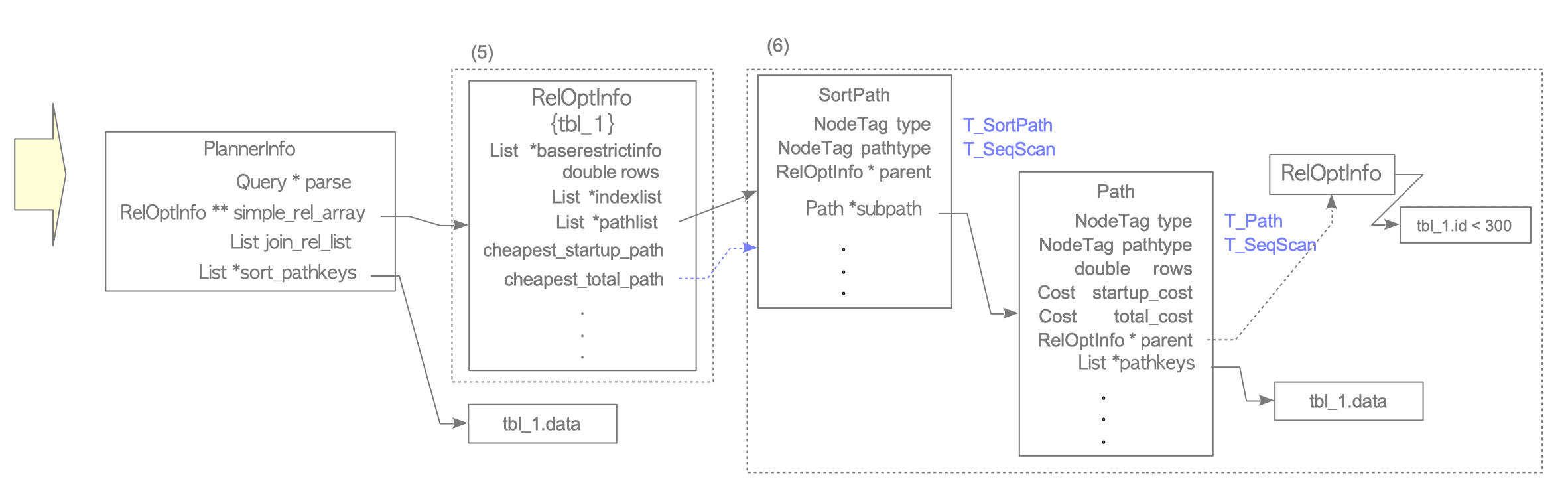
(1) Создает структуру RelOptInfo и сохраняет ее в массиве simple_rel_array файла PlannerInfo.
(2) В поле baserestrictinfo RelOptInfo добавляет условие WHERE.
Условие WHERE 'id<300' добавляется к baserestrictinfo при помощи функции distribute_restrictinfo_to_rels(), определенной в initsplan.c. Индексный список RelOptInfo равен NULL, поскольку целевая таблица не содержит связанных индексов.
(3) Добавляет ключ пути для сортировки в sort_pathkeys PlannerInfo с помощью функции standard_qp_callback(), определенной в planner.c.
Pathkey - это структура данных, представляющая порядок сортировки. В данном примере столбец 'data' добавлен в sort_pathkeys в качестве ключа пути, поскольку этот запрос содержит предложение ORDER BY.
(4) Создает структуру пути, оценивает стоимость последовательного сканирования с помощью функции cost_seqscan и записывает затраты в путь. После этого добавляет путь в RelOptInfo с помощью функции add_path(), определенной в pathnode.c.
Напомним, что структура Path содержит начальные и общие затраты, которые оцениваются при помощи функции cost_seqscan.
В данном примере планировщик оценивает только стоимость последовательного сканирования (так как индексы целевой таблицы отсутствуют). В связи с этим самый недорогойй путь доступа определяется автоматически.
- (5) Создает новую структуру RelOptInfo для обработки ORDER BY.
Обратите внимание, что новая структура RelOptInfo не содержит информации о предложении WHERE.
- (6) Создает путь сортировки и добавляет его в RelOptInfo.
Структура SortPath состоит из двух структур путей: path и subpath; path хранит информацию о самой операции сортировки, а subpath - самый недорогой путь.
Обратите внимание, что элемент 'parent' пути последовательного сканирования содержит ссылку на старую RelOptInfo, которая хранит предложение WHERE в baserestrictinfo. Поэтому на следующем этапе, то есть при создании дерева плана, планировщик может создать узел последовательного сканирования, содержащий условие WHERE в качестве 'фильтра', даже если новая RelOptInfo не содержит базовую ограничительную информацию.
SortPath
typedef struct SortPath
{
                    Path            path;
                    Path            *subpath;                      /* path representing input source */
} SortPath;
На основе самого недорогого пути доступаформируется дерево плана. Подробности описаны в разделе 3.3.3.
Пример 2
Теперь рассмотрим другой запрос с одной таблицей и двумя индексами, содержащий предложение WHERE.
testdb=# \d tbl_2
     Table "public.tbl_2"
Column | Type | Modifiers --------+---------+----------- id | integer | not null
data   | integer |
Indexes:
    "tbl_2_pkey" PRIMARY KEY, btree (id)
    "tbl_2_data_idx" btree (data)

testdb=# SELECT * FROM tbl_2 WHERE id < 240;
Рисунки описывает действия планировщика в данном случае.
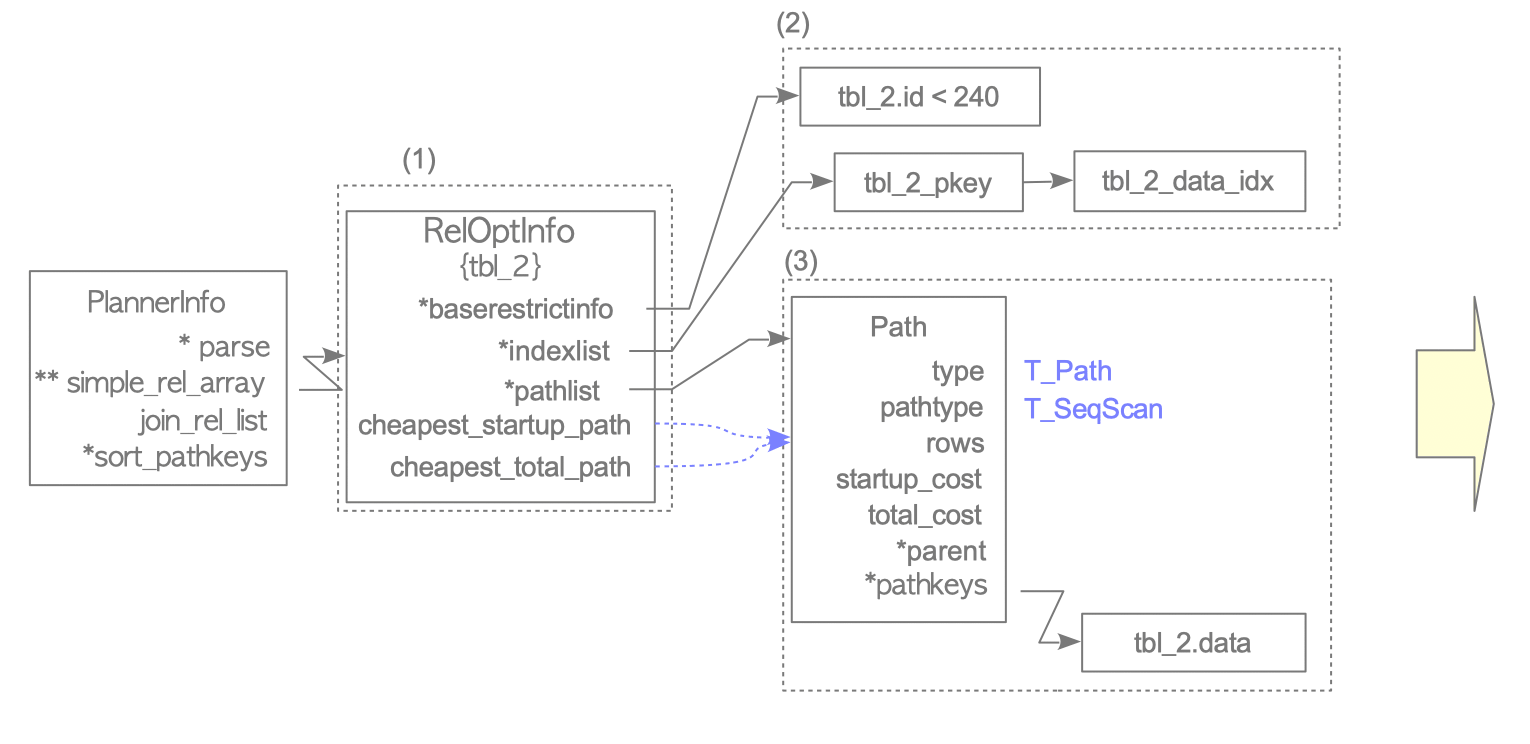
(1) Создает структуру RelOptInfo.
(2) В baserestrictinfo добавляет условие WHERE, в indexlist – индексы целевой таблицы.
В данном случае, в baserestrictinfo добавлено условие WHERE ‘id<240’, а в indexlist RelOptInfo добавлены два индекса - tbl_2_pkey и tbl_2_data_idx.
(3) Создает путь, оценивает стоимость последовательного сканирования, добавляет путь в pathlist RelOptInfo.
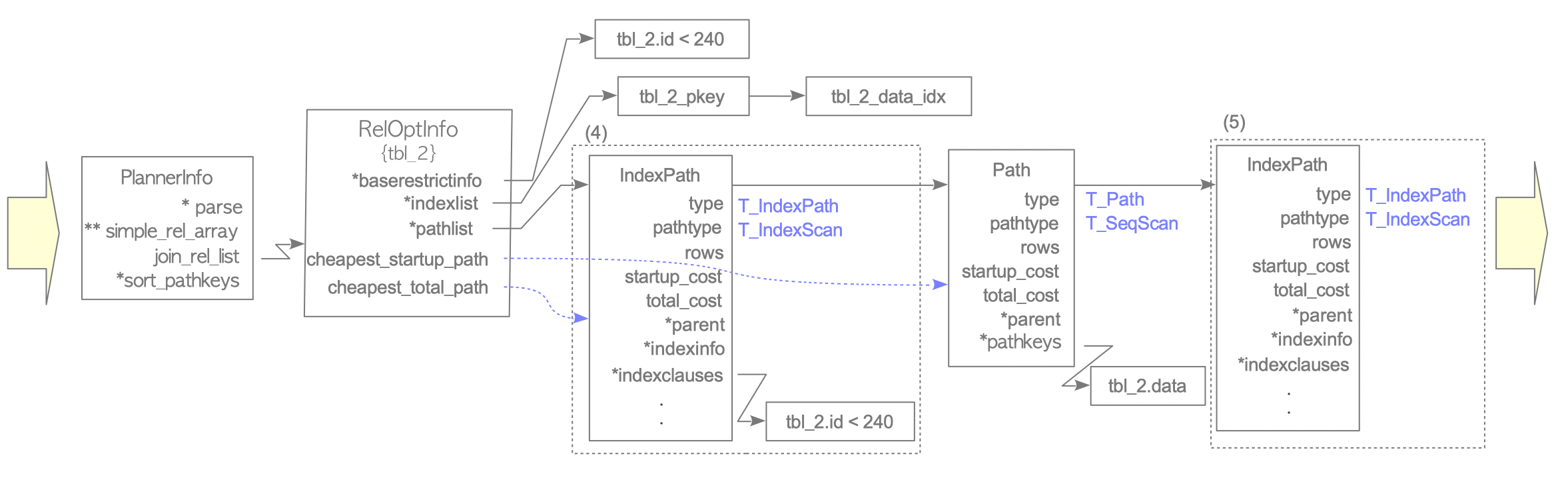
(4) Создает IndexPath, оценивает стоимость индексного сканирования, добавляет IndexPath в pathlist RelOptInfo с помощью функции add_path().
Поскольку в данном примере есть два индекса, tbl_2_pkey и tbl_2_data_idx, они обрабатываются по очереди. В первую очередь обрабатывается tbl_2_pkey.
Для tbl_2_pkey создается IndexPath, определяются начальная и общая стоимость. В данном случае tbl_2_pkey относится к столбцу ‘id’, предложение WHERE также содержит ‘id’; поэтому условие WHERE сохраняется в indexclauses IndexPath.
Отметим, что при добавлении путей доступа в pathlist функция add_path() добавляет пути в порядке возрастания общей стоимости. В данном случае общая стоимость индексного сканирования меньше, чем общая стоимость последовательного сканирования, поэтому путь индексного сканирования добавляется перед путем последовательного сканирования.
IndexPath
typedef struct IndexPath
{
                    Path                                path;
                    IndexOptInfo *indexinfo;
                    List                 *indexclauses;
                    List                 *indexorderbys;
                    List                 *indexorderbycols;
                    ScanDirection indexscandir;
                    Cost                                indextotalcost;
                    Selectivity indexselectivity;
} IndexPath;

/*
 * IndexOptInfo
 *                                     Per-index information for planning/optimization
 *
 *                                     indexkeys[], indexcollations[] each have ncolumns entries.
 *                                     opfamily[], and opcintype[]           each have nkeycolumns entries. They do
 *                                     not contain any information about included attributes.
 *
 *                                     sortopfamily[], reverse_sort[], and nulls_first[] have
 *                                     nkeycolumns entries, if the index is ordered; but if it is unordered,
 *                                     those pointers are NULL.
 *
 *                                     Zeroes in the indexkeys[] array indicate index columns that are
 *                                     expressions; there is one element in indexprs for each such column.
 *
 *                                     For an ordered index, reverse_sort[] and nulls_first[] describe the
 *                                     sort ordering of a forward indexscan; we can also consider a backward
 *                                     indexscan, which will generate the reverse ordering.
 *
 *                                     The indexprs and indpred expressions have been run through
 *                                     prepqual.c and eval_const_expressions() for ease of matching to
 *                                     WHERE clauses. indpred is in implicit-AND form.
 *
 *                                     indextlist is a TargetEntry list representing the index columns.
 *                                     It provides an equivalent base-relation Var for each simple column,
 *                                     and links to the matching indexprs element for each expression column.
 *
 *                                     While most of these fields are filled when the IndexOptInfo is created
 *                                     (by plancat.c), indrestrictinfo and predOK are set later, in
 *                                     check_index_predicates().
 */
#ifndef HAVE_INDEXOPTINFO_TYPEDEF
typedef struct IndexOptInfo IndexOptInfo;
#define HAVE_INDEXOPTINFO_TYPEDEF 1
#endif

struct IndexOptInfo
{
                    pg_node_attr(no_copy_equal, no_read, no_query_jumble)

                    NodeTag                        type;

                    /* OID of the index relation */
                    Oid                                                       indexoid;
                    /* tablespace of index (not table) */
                    Oid                                                       reltablespace;
                    /* back-link to index's table; don't print, else infinite recursion */
                    RelOptInfo *rel pg_node_attr(read_write_ignore);

                    /*
                    * index-size statistics (from pg_class and elsewhere)
                    */
                    /* number of disk pages in index */
                    BlockNumber pages;
                    /* number of index tuples in index */
                    Cardinality tuples;
                    /* index tree height, or -1 if unknown */
                    int                                                        tree_height;

                    /*
                    * index descriptor information
                    */
                    /* number of columns in index */
                    int                                                        ncolumns;
                    /* number of key columns in index */
                    int                                                        nkeycolumns;

                    /*
                    * table column numbers of index's columns (both key and included
                    * columns), or 0 for expression columns
                    */
                    int                                       *indexkeys pg_node_attr(array_size(ncolumns));
                    /* OIDs of collations of index columns */
                    Oid                                     *indexcollations pg_node_attr(array_size(nkeycolumns));
                    /* OIDs of operator families for columns */
                    Oid                                     *opfamily pg_node_attr(array_size(nkeycolumns));
                    /* OIDs of opclass declared input data types */
                    Oid                                     *opcintype pg_node_attr(array_size(nkeycolumns));
                    /* OIDs of btree opfamilies, if orderable.  NULL if partitioned index */
                    Oid                                     *sortopfamily pg_node_attr(array_size(nkeycolumns));
                    /* is sort order descending? or NULL if partitioned index */
                    bool               *reverse_sort pg_node_attr(array_size(nkeycolumns));
                    /* do NULLs come first in the sort order? or NULL if partitioned index */
                    bool               *nulls_first pg_node_attr(array_size(nkeycolumns));
                    /* opclass-specific options for columns */
                    bytea            **opclassoptions pg_node_attr(read_write_ignore);
                    /* which index cols can be returned in an index-only scan? */
                    bool               *canreturn pg_node_attr(array_size(ncolumns));
                    /* OID of the access method (in pg_am) */
                    Oid                                                       relam;

                    /*
                    * expressions for non-simple index columns; redundant to print since we
                    * print indextlist
                    */
                    List                 *indexprs pg_node_attr(read_write_ignore);
                    /* predicate if a partial index, else NIL */
                    List                 *indpred;

                    /* targetlist representing index columns */
                    List                 *indextlist;

                    /*
                    * parent relation's baserestrictinfo list, less any conditions implied by
                    * the index's predicate (unless it's a target rel, see comments in
                    * check_index_predicates())
                    */
                    List                 *indrestrictinfo;

                    /* true if index predicate matches query */
                    bool                                 predOK;
                    /* true if a unique index */
                    bool                                 unique;
                    /* is uniqueness enforced immediately? */
                    bool                                 immediate;
                    /* true if index doesn't really exist */
                    bool                                 hypothetical;

                    /*
                    * Remaining fields are copied from the index AM's API struct
                    * (IndexAmRoutine).  These fields are not set for partitioned indexes.
                    */
                    bool                                 amcanorderbyop;
                    bool                                 amoptionalkey;
                    bool                                 amsearcharray;
                    bool                                 amsearchnulls;
                    /* does AM have amgettuple interface? */
                    bool                                 amhasgettuple;
                    /* does AM have amgetbitmap interface? */
                    bool                                 amhasgetbitmap;
                    bool                                 amcanparallel;
                    /* does AM have ammarkpos interface? */
                    bool                                 amcanmarkpos;
                    /* AM's cost estimator */
                    /* Rather than include amapi.h here, we declare amcostestimate like this */
                    void                                 (*amcostestimate) () pg_node_attr(read_write_ignore);
};
(5) Создает еще один IndexPath, оценивает стоимость других индексных сканирований, добавляет путь индексного сканирования в pathlist RelOptInfo.
Далее определяются затраты, и в pathlist добавляется IndexPath. В данном случае, условие WHERE, относящееся к индексу tbl_2_data_idx, отсутствует; поэтому условия индекса - NULL.
Примечание: функция add_path() не всегда добавляет путь. Не будем вдаваться в поробности проесса ввиду его сложности.
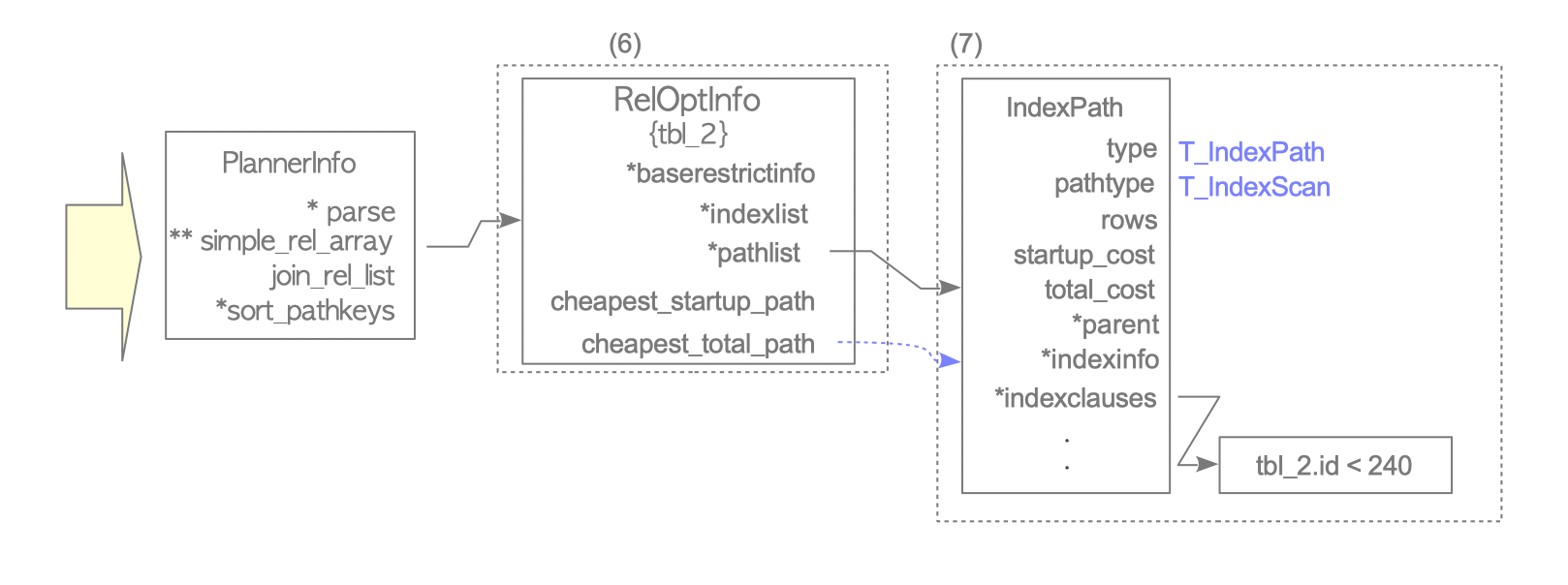
(6) Создает новую структуру RelOptInfo.
(7) Добавляет самый недорогой путь в pathlist новой RelOptInfo.
В данном случае самый недорогой путь – это путь индексного сканирования, использующий индекс tbl_2_pkey; таким образом, этот путь добавляется в pathlist новой RelOptInfo.
Формирование дерева планов
Заключительным шагом является формирование дерева планов на основе самого недорогого пути.
Корнем дерева планов является структура PlannedStmt, определенная в plannodes.h. Данная структура содердит 19 полей, самыми важными из которых являются следующие:
- commandType хранит тип операции, например, SELECT, UPDATE или INSERT.
- rtable хранит записи rangeTable.
- relationOids хранит идентификаторы объекта таблиц, связанных с запросом.
- plantree хранит дерево планов, состоящее из узлов плана, где каждый узел соответствует определенной операции (последовательное сканирование, сортировка и т.д.)
PlannedStmt
typedef struct PlannedStmt
{
                    pg_node_attr(no_equal, no_query_jumble)

                    NodeTag                        type;

                    CmdType                      commandType;            /* select|insert|update|delete|merge|utility */

                    uint64                             queryId;                         /* query identifier (copied from Query) */

                    bool                                 hasReturning;               /* is it insert|update|delete RETURNING? */

                    bool                                 hasModifyingCTE;      /* has insert|update|delete in WITH? */

                    bool                                 canSetTag;                    /* do I set the command result tag? */

                    bool                                 transientPlan;                /* redo plan when TransactionXmin changes? */

                    bool                                 dependsOnRole;           /* is plan specific to current role? */

                    bool                                 parallelModeNeeded; /* parallel mode required to execute? */

                    int                                                        jitFlags;                          /* which forms of JIT should be performed */

                    struct Plan *planTree;                     /* tree of Plan nodes */

                    List                 *rtable;                                            /* list of RangeTblEntry nodes */

                    List                 *permInfos;                                   /* list of RTEPermissionInfo nodes for rtable
                                                                                                                                                                   * entries needing one */

                    /* rtable indexes of target relations for INSERT/UPDATE/DELETE/MERGE */
                    List                 *resultRelations;       /* integer list of RT indexes, or NIL */

                    List                 *appendRelations;   /* list of AppendRelInfo nodes */

                    List                 *subplans;                                      /* Plan trees for SubPlan expressions; note
                                                                                                                                                                   * that some could be NULL */

                    Bitmapset  *rewindPlanIDs;           /* indices of subplans that require REWIND */

                    List                 *rowMarks;                                    /* a list of PlanRowMark's */

                    List                 *relationOids;            /* OIDs of relations the plan depends on */

                    List                 *invalItems;                                   /* other dependencies, as PlanInvalItems */

                    List                 *paramExecTypes; /* type OIDs for PARAM_EXEC Params */

                    Node              *utilityStmt;               /* non-null if this is utility stmt */

                    /* statement location in source string (copied from Query) */
                    int                                                        stmt_location;              /* start location, or -1 if unknown */
                    int                                                        stmt_len;                        /* length in bytes; 0 means "rest of string" */
} PlannedStmt;
Как уже было отмечено ранее, дерево плана состоит из нескольких узлов плана. Структура PlanNode – базовый узел, входящий в состав других узлов. Например, SeqScanNode состоит из PlanNode и целочисленной переменной ‘scanrelid’. PlanNode содержит 14 полей, в том числе:
- start-up cost и total_cost – стоимость операции, соответствующей данному узлу;
- rows – количество строк, подлежащих сканированию, определенное планировщиком;
- qual – список, хранящий условия квалификации.
PlanNode
/* ----------------
 *                                     Plan node
 *
 * All plan nodes "derive" from the Plan structure by having the
 * Plan structure as the first field.  This ensures that everything works
 * when nodes are cast to Plan's.  (node pointers are frequently cast to Plan*
 * when passed around generically in the executor)
 *
 * We never actually instantiate any Plan nodes; this is just the common
 * abstract superclass for all Plan-type nodes.
 * ----------------
 */
typedef struct Plan
{
                    pg_node_attr(abstract, no_equal, no_query_jumble)

                    NodeTag                        type;

                    /*
                    * estimated execution costs for plan (see costsize.c for more info)
                    */
                    Cost                                startup_cost;                 /* cost expended before fetching any tuples */
                    Cost                                total_cost;                     /* total cost (assuming all tuples fetched) */

                    /*
                    * planner's estimate of result size of this plan step
                    */
                    Cardinality plan_rows;                                        /* number of rows plan is expected to emit */
                    int                                                        plan_width;                                       /* average row width in bytes */

                    /*
                    * information needed for parallel query
                    */
                    bool                                 parallel_aware; /* engage parallel-aware logic? */
                    bool                                 parallel_safe;                /* OK to use as part of parallel plan? */

                    /*
                    * information needed for asynchronous execution
                    */
                    bool                                 async_capable;             /* engage asynchronous-capable logic? */

                    /*
                    * Common structural data for all Plan types.
                    */
                    int                                                        plan_node_id;              /* unique across entire final plan tree */
                    List                 *targetlist;                                       /* target list to be computed at this node */
                    List                 *qual;                                              /* implicitly-ANDed qual conditions */
                    struct Plan *lefttree;                         /* input plan tree(s) */
                    struct Plan *righttree;
                    List                 *initPlan;                                        /* Init Plan nodes (un-correlated expr
                                                                                                                                                                   * subselects) */

                    /*
                    * Information for management of parameter-change-driven rescanning
                    *
                    * extParam includes the paramIDs of all external PARAM_EXEC params
                    * affecting this plan node or its children.  setParam params from the
                    * node's initPlans are not included, but their extParams are.
                    *
                    * allParam includes all the extParam paramIDs, plus the IDs of local
                    * params that affect the node (i.e., the setParams of its initplans).
                    * These are _all_ the PARAM_EXEC params that affect this node.
                    */
                    Bitmapset  *extParam;
                    Bitmapset  *allParam;
} Plan;
ScanNode
/*
 * ==========
 * Scan nodes
 *
 * Scan is an abstract type that all relation scan plan types inherit from.
 * ==========
 */
typedef struct Scan
{
                    pg_node_attr(abstract)

                    Plan                                 plan;
                    Index                              scanrelid;                       /* relid is index into the range table */
} Scan;

/* ----------------
 *                                     sequential scan node
 * ----------------
 */
typedef struct SeqScan
{
                    Scan                                scan;
} SeqScan;
Далее будут описаны два дерева планов, сгенерированных из самых недорогих путей, описанных выше.
Пример 1
В данном случае SortNode добавляется к plantree структуры PlannedStmt, SeqScanNode добавляется к lefttree структуры SortNode. Смотри рисунок 22.
SortNode
* ----------------
 *                                     sort node
 * ----------------
 */
typedef struct Sort
{
                    Plan                                 plan;

                    /* number of sort-key columns */
                    int                                                        numCols;

                    /* their indexes in the target list */
                    AttrNumber *sortColIdx pg_node_attr(array_size(numCols));

                    /* OIDs of operators to sort them by */
                    Oid                                     *sortOperators pg_node_attr(array_size(numCols));

                    /* OIDs of collations */
                    Oid                                     *collations pg_node_attr(array_size(numCols));

                    /* NULLS FIRST/LAST directions */
                    bool               *nullsFirst pg_node_attr(array_size(numCols));
} Sort;

Пример 2
Самый недорогой путь – это путь индексного сканированя, поэтому дерево планов состоит только из структуры IndexScanNode.
IndexScanNode
/* ----------------
 *                                     index scan node
 *
 * indexqualorig is an implicitly-ANDed list of index qual expressions, each
 * in the same form it appeared in the query WHERE condition.  Each should
 * be of the form (indexkey OP comparisonval) or (comparisonval OP indexkey).
 * The indexkey is a Var or expression referencing column(s) of the index's
 * base table.  The comparisonval might be any expression, but it won't use
 * any columns of the base table.  The expressions are ordered by index
 * column position (but items referencing the same index column can appear
 * in any order).  indexqualorig is used at runtime only if we have to recheck
 * a lossy indexqual.
 *
 * indexqual has the same form, but the expressions have been commuted if
 * necessary to put the indexkeys on the left, and the indexkeys are replaced
 * by Var nodes identifying the index columns (their varno is INDEX_VAR and
 * their varattno is the index column number).
 *
 * indexorderbyorig is similarly the original form of any ORDER BY expressions
 * that are being implemented by the index, while indexorderby is modified to
 * have index column Vars on the left-hand side.  Here, multiple expressions
 * must appear in exactly the ORDER BY order, and this is not necessarily the
 * index column order.  Only the expressions are provided, not the auxiliary
 * sort-order information from the ORDER BY SortGroupClauses; it's assumed
 * that the sort ordering is fully determinable from the top-level operators.
 * indexorderbyorig is used at runtime to recheck the ordering, if the index
 * cannot calculate an accurate ordering.  It is also needed for EXPLAIN.
 *
 * indexorderbyops is a list of the OIDs of the operators used to sort the
 * ORDER BY expressions.  This is used together with indexorderbyorig to
 * recheck ordering at run time.  (Note that indexorderby, indexorderbyorig,
 * and indexorderbyops are used for amcanorderbyop cases, not amcanorder.)
 *
 * indexorderdir specifies the scan ordering, for indexscans on amcanorder
 * indexes (for other indexes it should be "don't care").
 * ----------------
 */
typedef struct Scan
{
                    pg_node_attr(abstract)

                    Plan                                 plan;
                    Index                              scanrelid;                       /* relid is index into the range table */
} Scan;

typedef struct IndexScan
{
                    Scan                                scan;
                    Oid                                                       indexid;                          /* OID of index to scan */
                    List                 *indexqual;                                    /* list of index quals (usually OpExprs) */
                    List                 *indexqualorig;         /* the same in original form */
                    List                 *indexorderby;          /* list of index ORDER BY exprs */
                    List                 *indexorderbyorig;   /* the same in original form */
                    List                 *indexorderbyops;   /* OIDs of sort ops for ORDER BY exprs */
                    ScanDirection indexorderdir;         /* forward or backward or don't care */
} IndexScan;
В данном случае предложение WHERE 'id<240' является предикатом доступа, поэтому оно хранится в indexqual IndexScanNode.


